




Architecture is a visible expression of a culture’s values, beliefs, and dreams over time. It is a “living art” that not only preserves history but also influences how people live, interact, and see the world around them.
Architecture protects and carries forward history. Famous structures like the Great Pyramids or Gothic cathedrals tell stories about the religious beliefs, skills, and ambitions of earlier civilizations.Buildings communicate identity through their design, materials, and form.
By 2026, architecture has moved beyond visual beauty to focus on environmental responsibility. Architects now use passive cooling methods and sustainable materials to reduce the impact of climate change and support long-term urban living. 
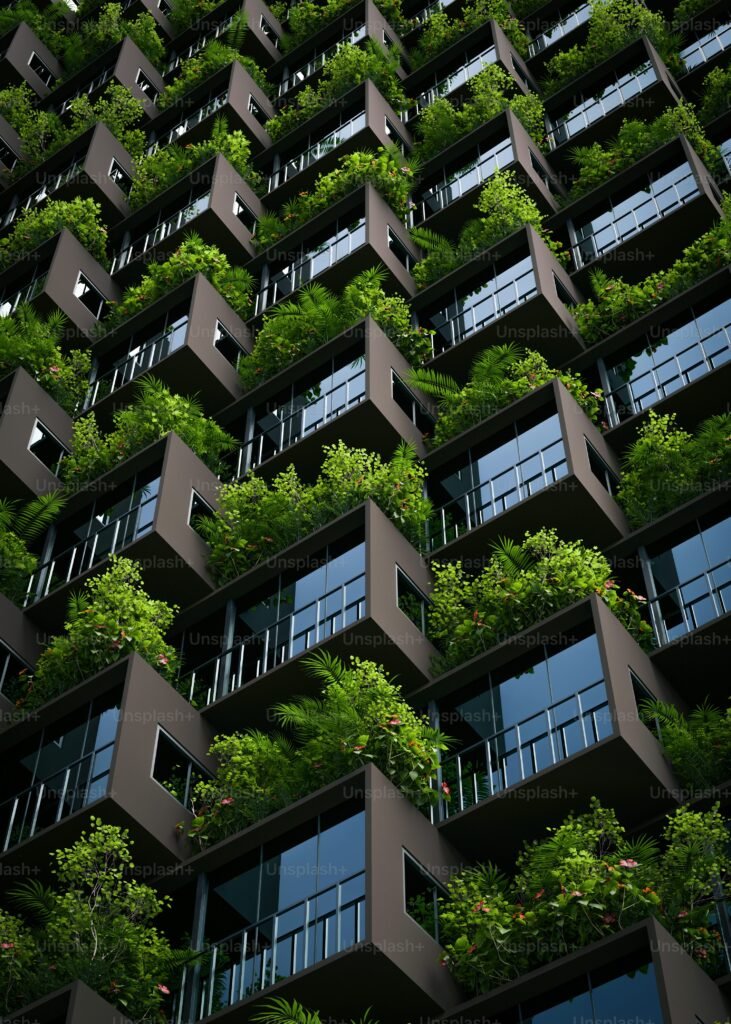
Modern architecture focuses on well-being and inclusivity. Spaces designed with natural light, greenery, and open areas help reduce stress and improve mental health, creating healthier cities.
Architecture is not just a background to our lives—it actively shapes them. As architect Sir Norman Foster said, “the way we construct is a mirror of the way we live.” How we design and build today will shape the lives of future generations.
The Essence of Architecture Design
At its heart, architecture is about bringing art and science together to create meaningful spaces—not just buildings. Good design goes beyond walls and roofs. It responds to how people live, feel, and connect with their surroundings.
The Basic Idea Behind Good Architecture
For centuries, architects have followed three simple principles first explained by Vitruvius:
Strength:
A building should be strong and well-built so it can last for years and handle natural conditions.
Function:
It should work well for the people using it. Spaces need to be practical and comfortable for everyday activities.
Beauty:
A building should look good and feel good. It should create a positive emotional response, not just serve a purpose.
What Architects Work With
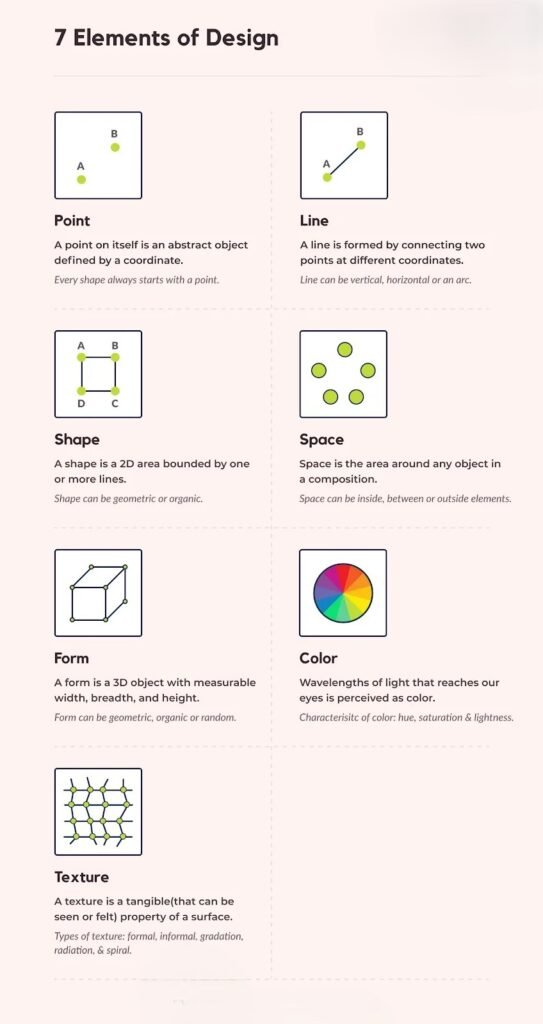
To create good architecture, designers focus on a few key elements:
Space and Form:
Space is where life happens, and form is the shape that holds it together.
Light and Materials:
Light sets the mood of a place, while materials affect how a building feels and looks.
Design Principles:
Balance, proportion, rhythm, and hierarchy help bring all these elements together in a way that feels organized and natural.
Scale:
This makes sure buildings feel right for people—not too massive or overwhelming.
Architecture vs. Just a Building
Not every building is architecture. What makes architecture special is the concept—the main idea behind the design. A building is simply something constructed, but architecture is a thoughtful response to culture, history, and future needs.
How Architecture Is Changing Today
By 2026, architecture is about more than appearance:
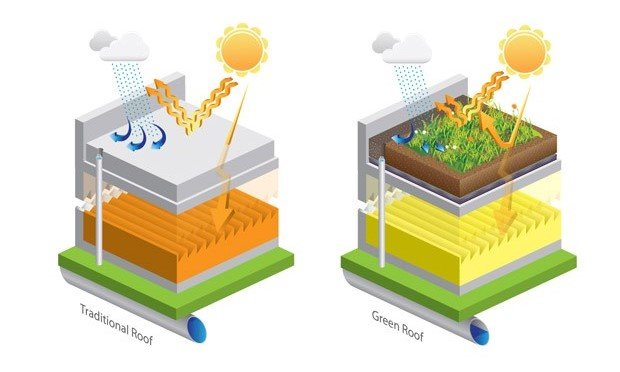
Sustainability:
Designing in an eco-friendly way is now essential, not optional.
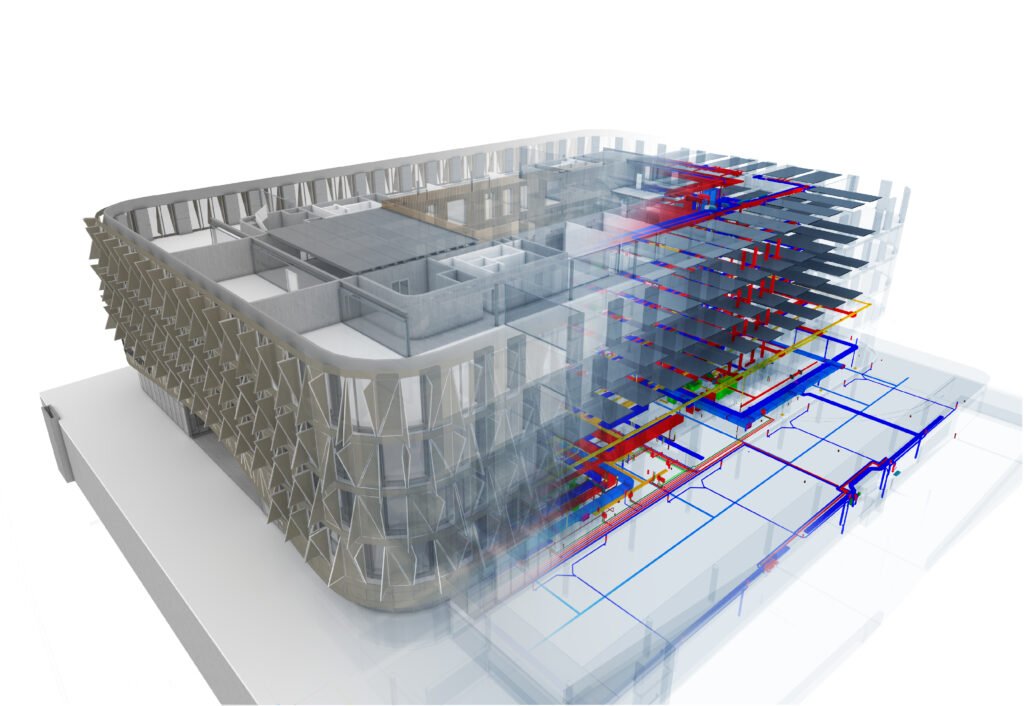
Technology:
Tools like BIM and AI help create smarter spaces that can adjust to how people use them.
Historical Evolution
Timeline of Major Architectural Eras
Architecture has changed a lot over time. Each period reflects how people lived, what materials they had, and what they believed in.
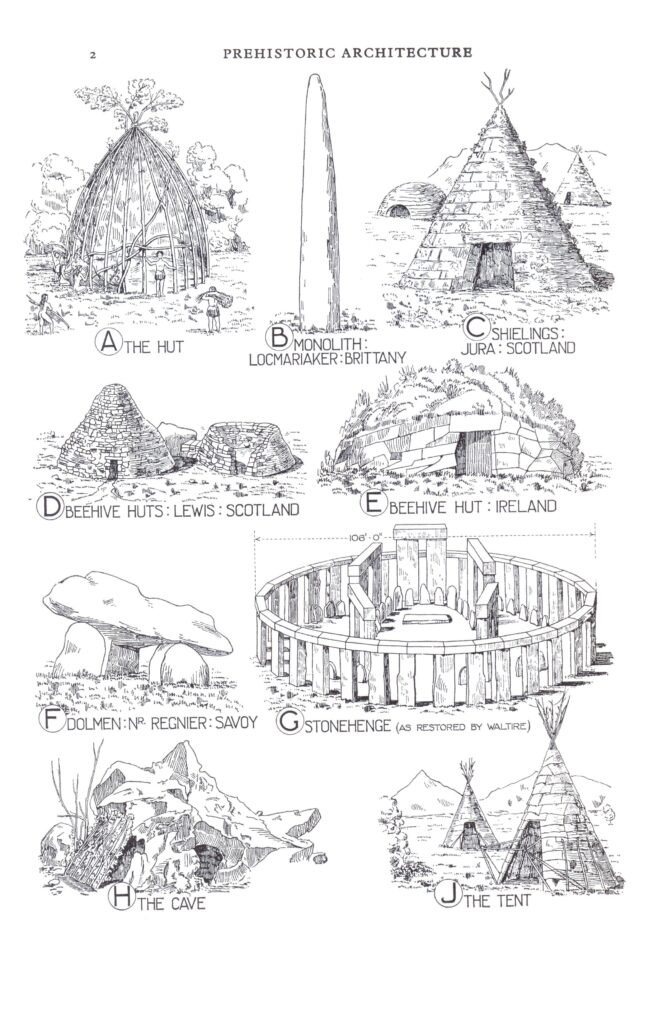
🪨 Prehistoric Architecture (11,600 BCE – 3,500 BCE)
Early humans slowly moved from living in caves to building simple shelters like huts made from wood, stone, and even mammoth bones.
Some of the earliest monumental structures include Stonehenge and Göbekli Tepe, showing that architecture already had social and spiritual meaning.
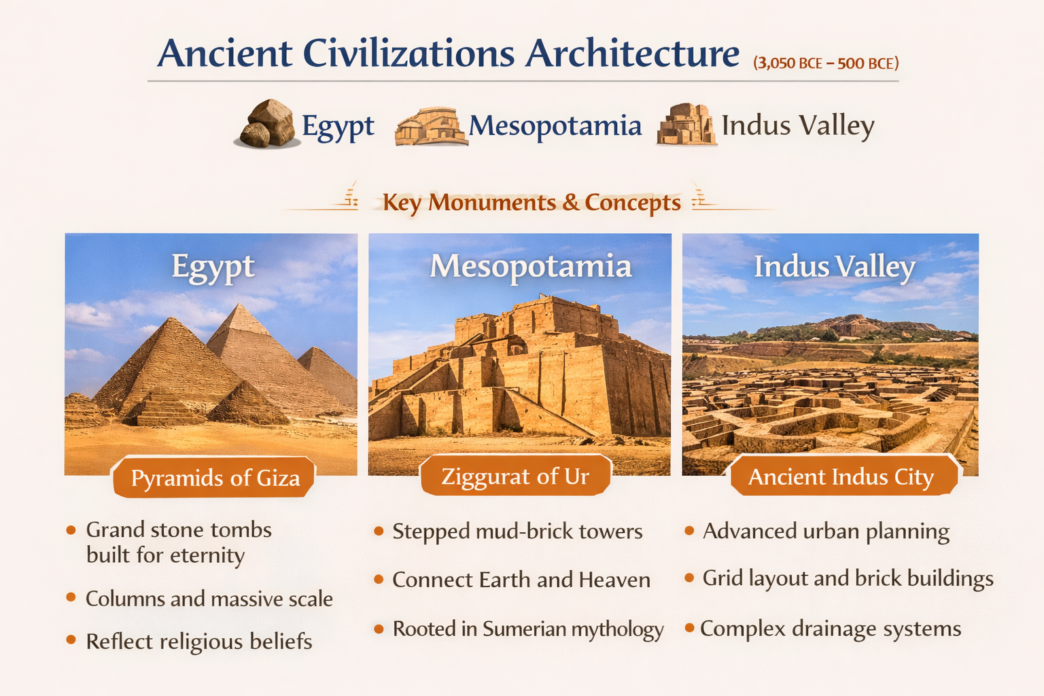
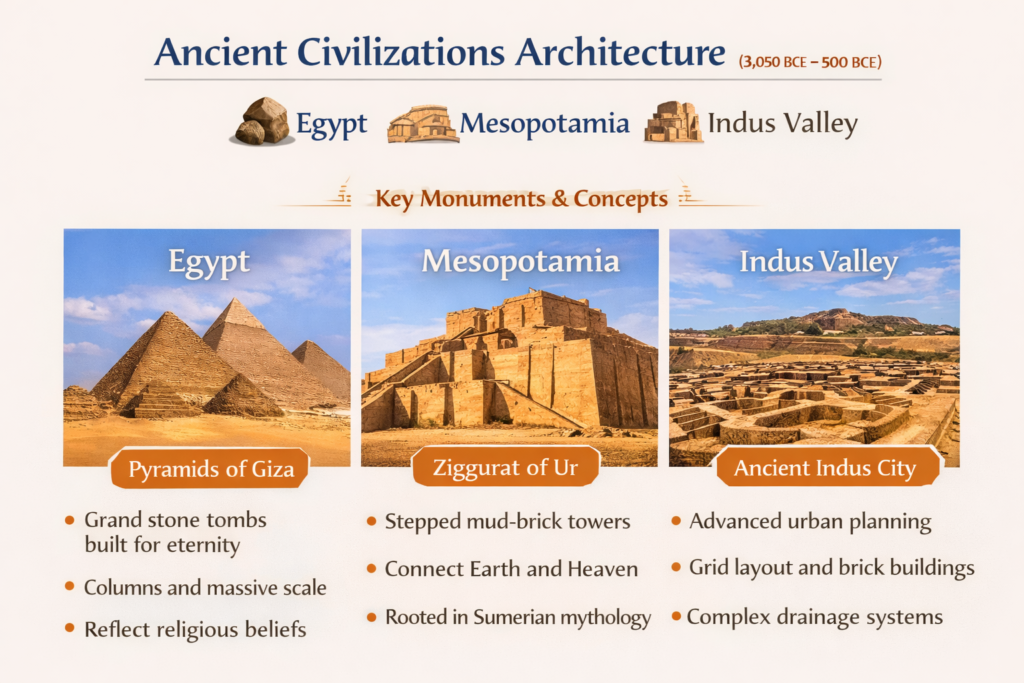
🏛️ Ancient Civilizations (3,050 BCE – 500 BCE)
Egypt:
Egyptian architecture focused on massive stone structures built for religion and the afterlife. The Pyramids of Giza show power, permanence, and belief in eternity.
Mesopotamia:
Known for ziggurats, stepped mud-brick towers built to connect the earth with the gods.
Indus Valley:
Cities like Harappa and Mohenjo-daro had advanced planning, grid layouts, and excellent drainage systems—far ahead of their time.
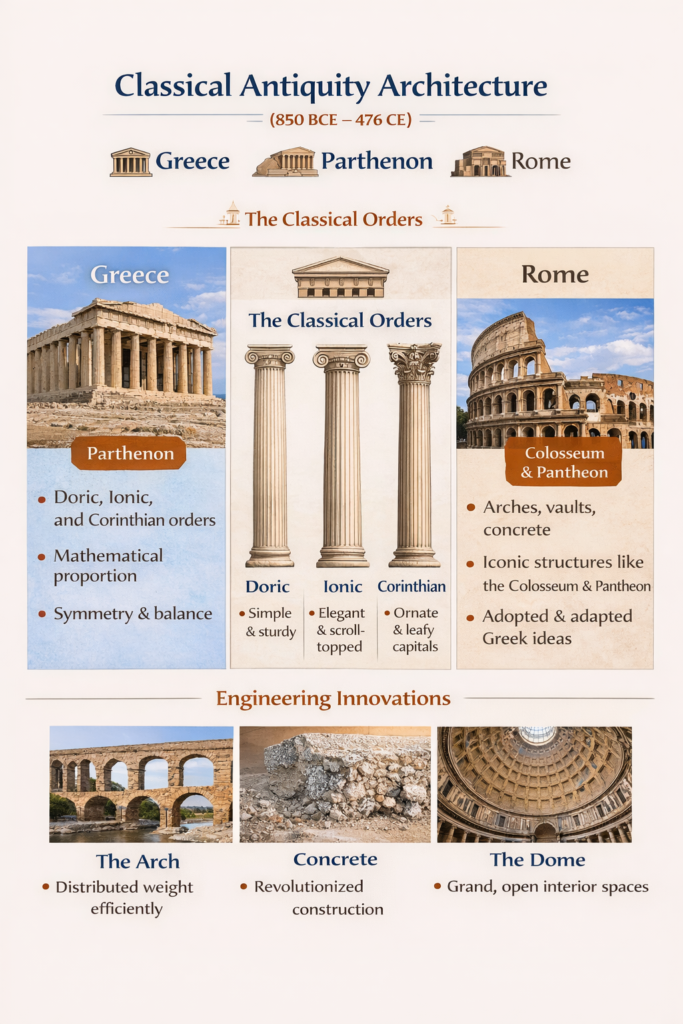
🏺 Classical Antiquity (850 BCE – 476 CE)
Greek Architecture:
Greeks focused on beauty, balance, and proportion. They developed the Doric, Ionic, and Corinthian columns. The Parthenon is a perfect example.
Roman Architecture:
Romans were brilliant engineers. They introduced concrete, arches, and domes, allowing them to build large public spaces like the Colosseum and the Pantheon.
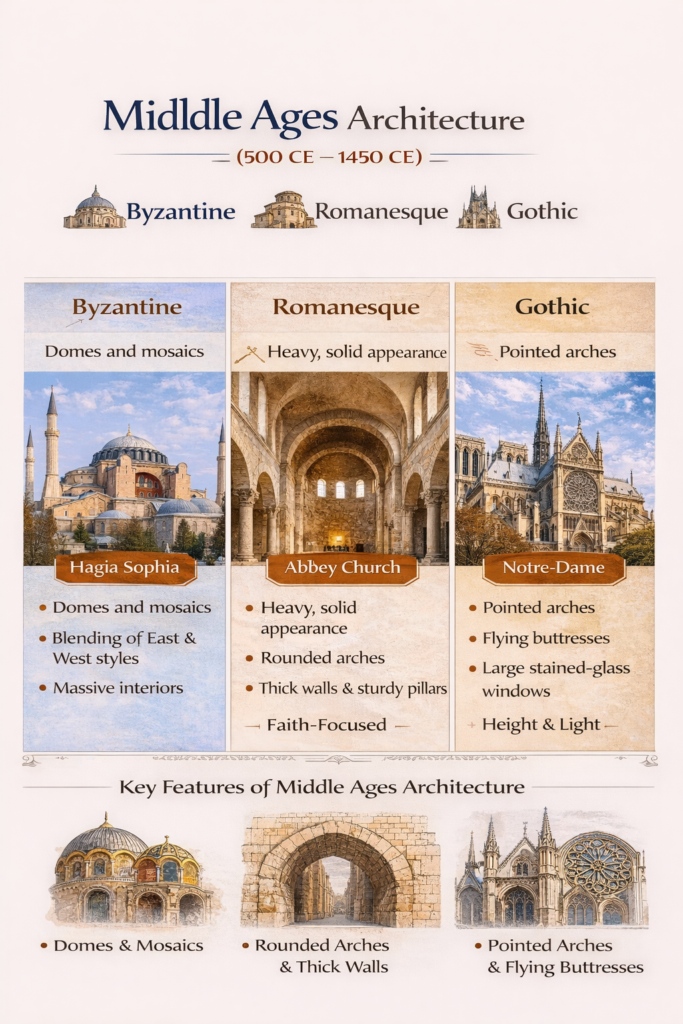
⛪ Middle Ages (500 CE – 1450 CE)
Byzantine:
Combined Eastern and Western styles, using large domes and colorful mosaics. Hagia Sophia is the best example.
Romanesque:
Heavy walls, thick pillars, and rounded arches were used to support large churches.
Gothic:
Introduced pointed arches, flying buttresses, and stained-glass windows, allowing buildings to grow taller and brighter. Notre-Dame Cathedral is iconic.
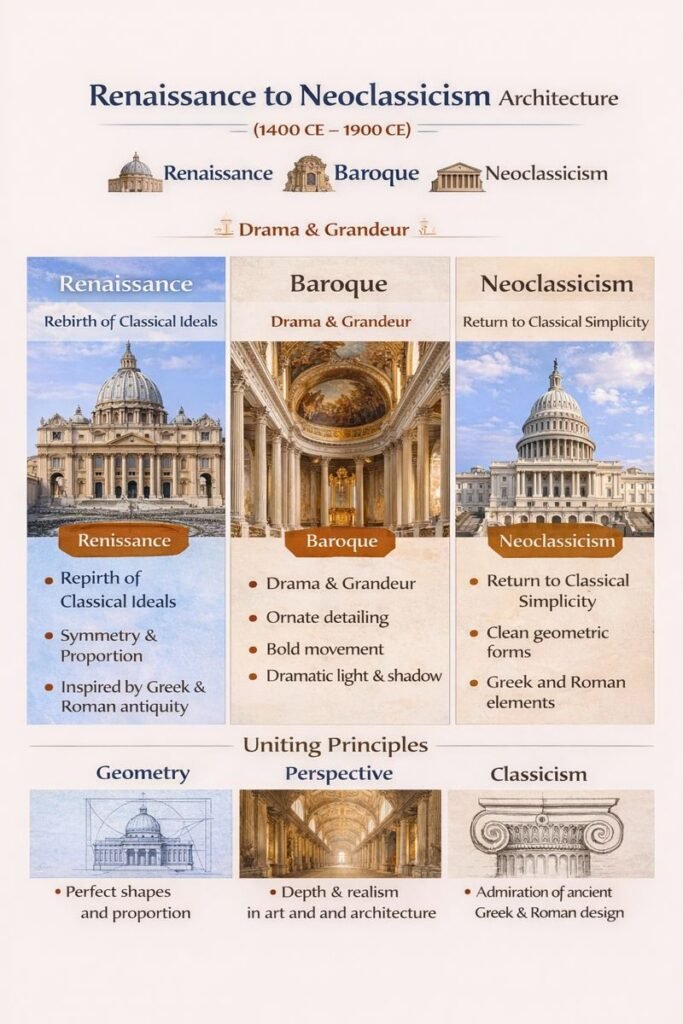
🎨 Renaissance to Neoclassicism (1400 CE – 1900 CE)
Renaissance:
Marked a return to classical ideas, focusing on symmetry, proportion, and human scale.
Baroque:
More dramatic and decorative, with bold forms, movement, and dramatic light.
Neoclassical:
A reaction against Baroque excess—simpler designs inspired by Greek and Roman architecture.
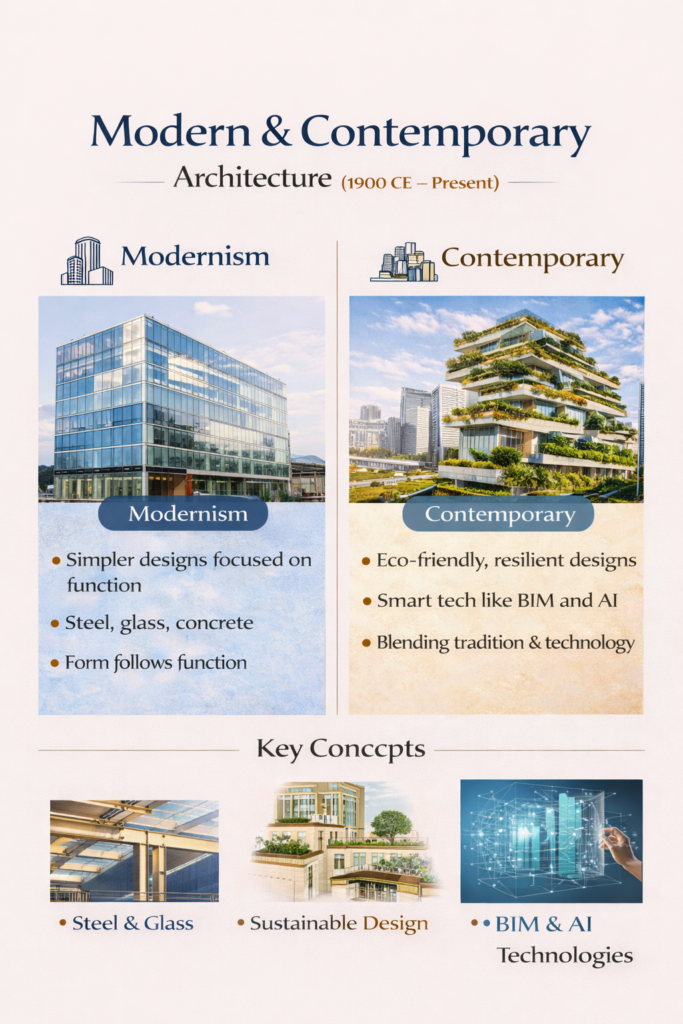
🏙️ Modern & Contemporary Architecture (1900 CE – Present)
Modernism:
Focused on function over decoration. Steel, glass, and concrete made clean, simple forms possible. The idea was: “form follows function.”
Contemporary Architecture (2026):
Today, architecture blends technology with tradition. The focus is on sustainability, AI-driven design, and resilient cities that adapt to climate and human needs.
Evolution of Key Structural Elements
Here are a few important building elements that changed architecture forever:
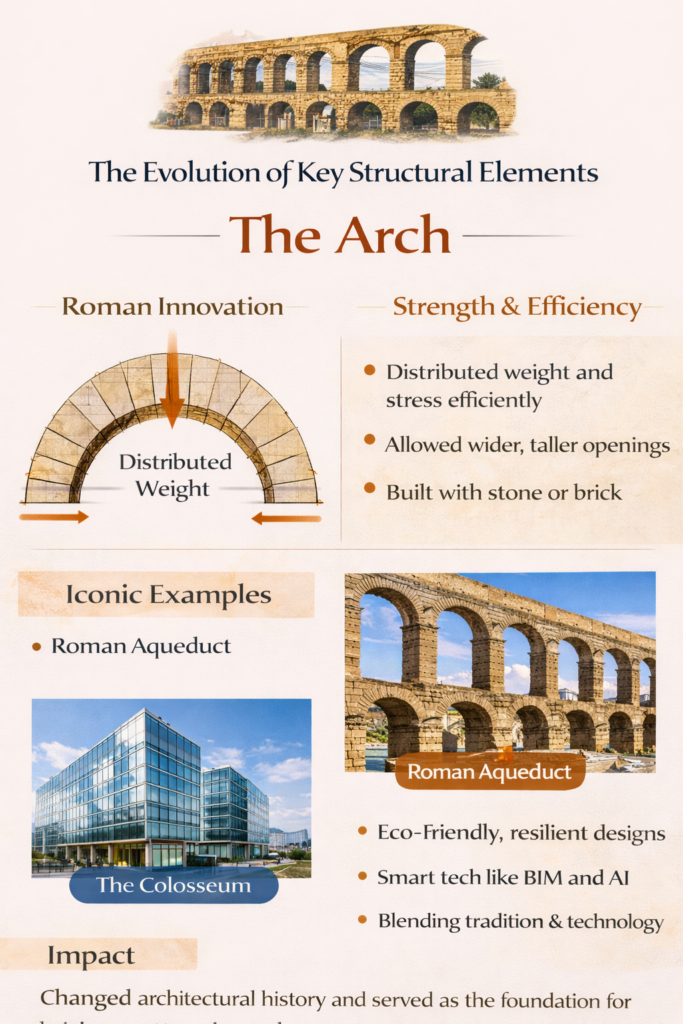
🏗️ The Arch
Developed by the Romans, arches helped distribute weight evenly, allowing wider doors, bridges, and taller buildings.
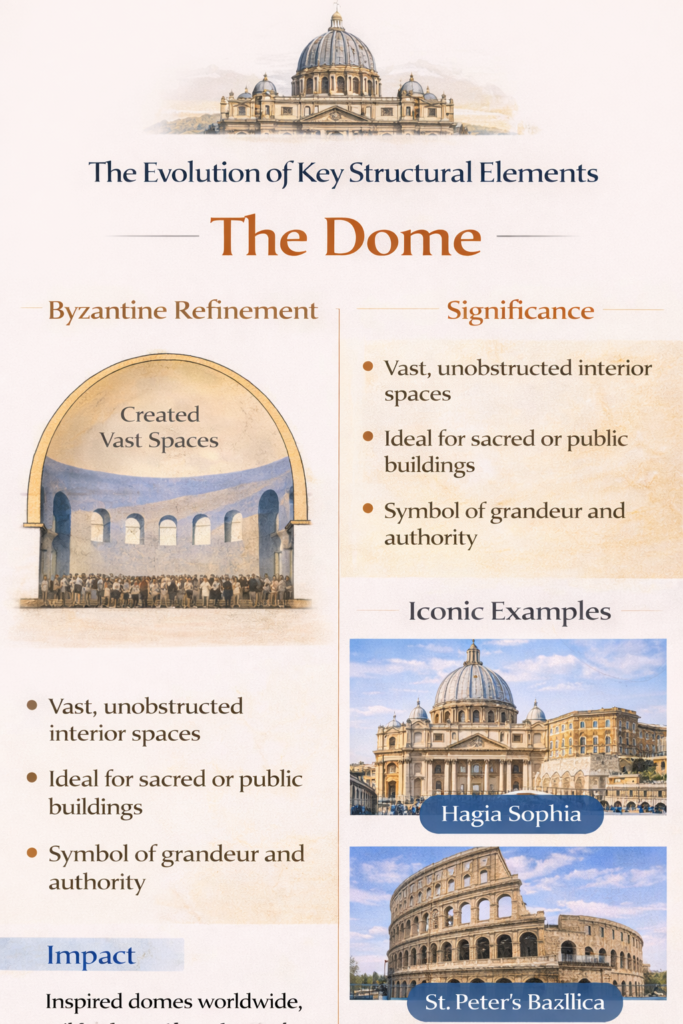
🟠 The Dome
Perfected during the Byzantine period, domes created large open interior spaces for religious and public buildings.
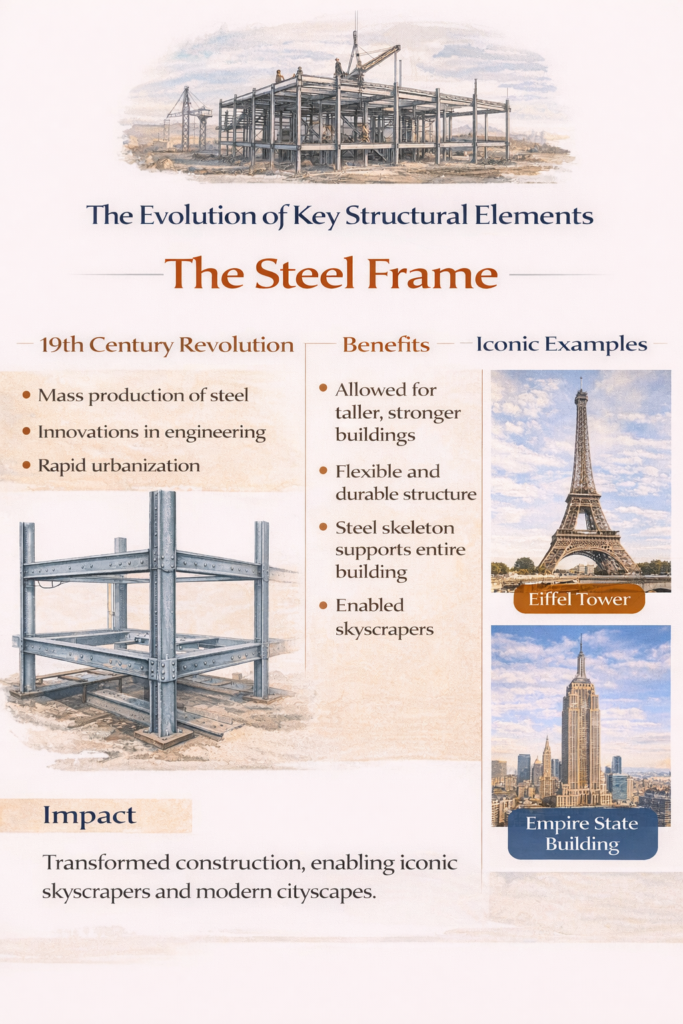
🏢 Steel Frame
Introduced during the Industrial Revolution, steel frames made skyscrapers possible and changed city skylines forever.
The Design Process
The architectural design process usually happens step by step. It starts with research, where architects look at the site, climate, rules, budget, and what the users need. After that comes the concept stage, where early ideas take shape through sketches, drawings, and simple models.
The architectural design process follows a clear set of steps that help turn an idea into a finished building. The American Institute of Architects (AIA) defines five main phases, but in practice, many projects go through additional stages before and after design, making it a total of eight phases.
Core Phases of Architectural Design
The architectural design process follows a clear sequence so that ideas move smoothly from concept to construction. Think of it as a journey from idea to reality.
📝 1. Pre-Design (Programming)
This is the thinking and planning stage.
Here, the architect tries to fully understand the problem before jumping into design. They talk to the client, study the site, check the budget, and understand what the building needs to do. All of this information is organized into a document called the building program.
✏️ 2. Schematic Design (SD)
This is where design begins to take shape.
Architects start sketching rough ideas, simple floor plans, and basic building forms. Nothing is final yet — it’s about exploring options and understanding how the building fits on the site.
📐 3. Design Development (DD)
Here, the chosen idea gets more detailed and refined.
Room layouts become clearer, window and door locations are fixed, and early material choices are made. The design now looks much closer to what will actually be built.
📄 4. Construction Documents (CD)
This is the technical and most detailed stage.
Architects prepare precise drawings and written specifications that contractors will use to build the project. These drawings include dimensions, materials, structural details, and services.
🏛️ 5. Building Permits
Before construction starts, the design must be approved by authorities.
The drawings are submitted to local government bodies to ensure the building follows zoning laws, safety rules, and building codes.
💰 6. Bidding and Negotiation
Now it’s time to choose who will build it.
Contractors review the drawings and submit cost estimates. The architect helps the client compare bids and select the best contractor for the budget and quality.
🏗️ 7. Construction Administration (CA)
This happens while the building is being constructed.
The architect visits the site regularly to make sure the work matches the design. They also answer questions, handle changes, and solve problems that come up on site.
🏠 8. Post-Occupancy Evaluation (POE)
This is the learning stage after completion.
Once people start using the building, the architect checks how well it performs. Feedback helps improve future designs.
Why This Step-by-Step Process Matters
✔ Saves money by catching problems early
✔ Avoids legal issues by meeting codes and regulations
✔ Keeps everyone aligned through regular feedback
✔ Uses technology like BIM and AI to reduce errors and improve efficiency
.
Sustainability and Technology
Contemporary architectural design strongly focuses on sustainability and technology. Since buildings consume a large share of global energy, architects now prioritize energy efficiency, natural light and ventilation, and environmentally responsible materials. Strategies such as green roofs, passive design, and high-performance façades are widely used, supported by rating systems like LEED and BREEAM. Sustainability today also addresses social and economic needs, ensuring buildings are inclusive, flexible, and long-lasting. At the same time, digital tools like BIM, parametric design, and AI are transforming how architects design, analyze, and innovate.
Design and Planning Technologies
Today, architects rely heavily on digital tools to design smarter and more sustainable buildings. Building Information Modeling (BIM) allows architects, engineers, and contractors to work together on a shared 3D model. This makes it easier to test energy performance, reduce material waste, and identify problems before construction even starts.
Energy modeling and simulation tools help designers understand how a building will use energy based on its orientation, climate, and materials. By doing this early, architects can improve natural ventilation, daylighting, and insulation, reducing the need for artificial lighting and mechanical systems.
Artificial Intelligence (AI) is also changing the way buildings are designed. AI can analyze large amounts of data to suggest efficient layouts, predict how a building will perform, and even help with long-term maintenance and energy optimization.
Virtual Reality (VR) and Augmented Reality (AR) make design more interactive. Clients and designers can virtually walk through a building, experience lighting and airflow, and test sustainable choices before anything is built.
Construction and Material Innovations
New materials and construction methods are making buildings more efficient and durable. Smart materials, such as self-healing concrete or glass that adjusts to sunlight, reduce energy use and long-term maintenance.
Modular and prefabricated construction involves building components off-site, which saves time, reduces waste, and improves construction quality. Similarly, 3D printing allows for precise, customized construction using fewer materials, often including recycled or locally sourced resources.
Operation and Management Systems
Technology continues to play a role even after a building is completed. Smart building systems and IoT sensors monitor temperature, lighting, air quality, and occupancy in real time. This data helps automatically adjust systems like heating, cooling, and lighting, cutting down energy use and operating costs.
Modern buildings also integrate renewable energy sources such as solar panels, wind energy, and geothermal systems, often paired with energy storage to move toward net-zero energy use.
In addition, advanced water management systems collect rainwater and recycle greywater, helping reduce freshwater consumption and manage water more efficiently.
Overall, these technologies are helping create buildings that are not only smarter and more efficient, but also more resilient and better connected to the natural environment.
Architecture and Society
Architecture and society are closely connected, constantly influencing each other. Buildings don’t just provide shelter—they reflect how a society thinks, what it values, and how advanced it is. At the same time, architecture shapes the way people live, interact, and experience their surroundings.
Architecture as a Mirror of Society
Architecture often tells the story of a culture. Buildings act like physical memories, preserving history and identity. In India today, for example, there is a renewed interest in traditional styles and local materials like terracotta and lime plaster, showing a growing respect for regional culture and heritage.
Buildings have also long reflected social values and power structures. Ancient pyramids and Gothic cathedrals symbolized religious beliefs and authority. In contrast, modern civic buildings are designed to feel open and welcoming, reflecting today’s emphasis on transparency, democracy, and public participation.
Design trends also respond directly to social challenges. The growing practice of reusing old buildings—such as converting factories into cultural or community spaces—shows how society is responding to environmental concerns and the need for sustainability.
Architecture as a Force for Social Change
Architecture doesn’t just reflect society—it actively influences it. The way spaces are designed affects how people feel and behave. Well-designed parks, plazas, and community centers encourage social interaction and help reduce isolation.
Modern architecture also places strong importance on inclusivity. Designers now focus on making spaces accessible to everyone, including the elderly and people with disabilities, so that no one feels excluded.
Wellness has become a major focus as well. Many contemporary buildings use natural elements like plants, daylight, and fresh air to improve mental health and overall well-being. These human-centered designs aim to make spaces calmer, healthier, and more supportive.
Architecture also plays a key role in urban renewal. Thoughtful design can breathe new life into neglected areas, creating jobs, boosting local economies, and forming compact “micro-cities” where people can live, work, and relax in one place.
Key Connections Between Society and Architecture Today
- Sustainability: As climate concerns grow, architects are moving toward designs that restore and protect the environment.
- Technology: The demand for efficiency and connectivity has led to smart buildings that adapt to users through AI and connected systems.
- Public Health: Greater awareness of mental health is shaping designs that focus on comfort, calmness, and connection to nature.
- Urban Growth: Rising population density is driving the creation of flexible, mixed-use spaces that serve multiple functions throughout the day.
Conclusion
Architecture design is more than just how buildings look. It shapes how people live, how cities develop, and how societies express what they value. As challenges like climate change, rapid urban growth, and new technologies continue to grow, architecture plays an increasingly important role. By combining creativity, responsibility, and innovation, architectural design helps create not only buildings, but a more sustainable and meaningful future.